
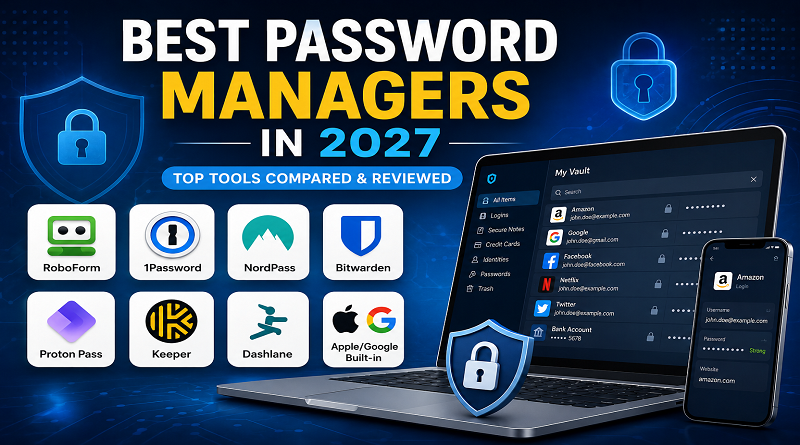
Best Password Managers in 2027
Quick gut check: how many of your passwords are some version of the same one you’ve been reusing since 2019? If you’re not sure, that’s answer enough. Data breaches expose billions of credentials every year, and once one password leaks, every other account sharing it becomes a target too.
A password manager fixes this in one move – it generates a strong, unique password for every account, stores them all in an encrypted vault, and autofills them when you need them. You only have to remember one master password, ever again.
Below is a practical breakdown of the best password managers in 2027: what each one does well, where it falls short, and which one actually fits your situation – whether that’s just you, your family, or a small team. (For the rest of your security stack, check our cybersecurity hub.)
How We Picked These
Every pick below was evaluated on the same criteria: encryption strength and security architecture, ease of everyday use (autofill reliability, app quality), platform coverage, price relative to features, and any standout extras that justify a higher tier. We weighted real day-to-day usability heavily – the most secure password manager in the world is worthless if it’s frustrating enough that you stop using it.
The Best Password Managers of 2027
- RoboForm – Best Overall
RoboForm has become a consistent top pick across independent reviews this year, and the reason comes down to a rare combination: strong security fundamentals, biometric login support, and genuinely affordable pricing. It covers the basics well – password generation, autofill, secure sharing – without the bloat some competitors pile on.
Why it stands out: the pricing. RoboForm’s premium plan starts at well under $1/month on longer-term billing, and its family plan (covering up to 5 users with shared folders and full sync) is one of the cheapest ways to secure an entire household.
Best for: anyone who wants strong security without paying premium prices – individuals and families alike.
- 1Password – Best for Sharing and Teams
There are very few apps out there that have specialized in shared logins like 1Password has done. Its sharing capabilities provide a higher level of control over who gets to see what information compared to the majority of its competitors.
What Makes It Different: It enables the use of the feature called Travel Mode, which allows one to conveniently erase sensitive vaults from mobile devices when crossing international borders, and it is very good at using its cooperation with third-party breach-monitoring services.
Best for: families or small teams that need to share logins often.
- NordPass – Best All-Around Balance
NordPass remains one of the most well-rounded services – it solves all its basic functions (secure password generation, speedy autofill, user-friendly sync across devices) and provides some really handy features such as Dark Web Monitoring, which notifies the user if their credentials or email appear in a known breach, and Email Masking, which generates some alias addresses to minimize spam and trackability.
What makes it unique: the business plan has a vault performance dashboard, which alerts the owners about weak and duplicated passwords used by the whole team. This is a good solution for small business owners willing to understand everything without being overly controlling.
Best suited for: people looking for trustworthy security with smooth work and no need for troublesome settings.
Why it stands out: the business tier includes a vault health dashboard that flags weak or reused passwords across a whole team – useful for small business owners who want visibility without micromanaging.
- Bitwarden – Best for Compatibility (and Best Free Tier)
Bitwarden is open-source, which means its code has been independently audited and scrutinized by the security community — a meaningful trust signal if you’re cautious about handing over your entire password vault to a closed-source company. Its free tier is also genuinely generous, covering unlimited passwords across unlimited devices.
Why it stands out: compatibility. Bitwarden works reliably across nearly every platform and browser, including less common ones many competitors ignore.
Best for: budget-conscious users and anyone who prefers open-source software for security-critical tools.
- Proton Pass – Best for Privacy
Proton Pass has been developed by the same team that made Proton Mail and Proton VPN, hence the emphasis on privacy. This password manager allows you to anonymize your email during the sign-up process, and it operates based on the principles of privacy.
What makes it unique: If you already have other Proton products, then you will enjoy seamless integration of Proton Pass into the ecosystem, as Proton Unlimited encompasses all the products of the brand (including VPN).
Best for: Privacy-first customers who are already within the Proton ecosystem.
- Keeper – Best for Advanced Security
Keeper leverages the enterprise-grade security system, which applies the 256-bit AES encryption system paired with a zero-knowledge architecture, meaning even Keeper cannot see your data. Moreover, Keeper provides extensive customization options for power users who require advanced settings.
Why it stands out: the security measures of Keeper have been tested thoroughly and received positive feedback concerning the results of the audit.
Best for: security-conscious users and businesses that want maximum configurability.
- Dashlane – Best for Families
Dashlane’s family plans are built with non-technical users in mind – clean interface, simple setup, and dark web monitoring included even on mid-tier plans, so parents can keep an eye on the whole household’s exposure without extra cost.
Best for: families who want something simple enough that everyone will actually use it.
- Apple Passwords / Google Password Manager – Free, Built-In, Limited
If you are thoroughly invested in one ecosystem and are looking for a free tool that requires no installation, Apple Passwords (iOS/macOS) and Google Password Manager (Chrome) can take care of the basics. The only downside is that they are quite limited when it comes to other systems. Google Password Manager, in particular, can hardly be used outside Chrome and Android; for this reason, it cannot be considered a go-to solution for the users that rely on a set of different devices.
Best suited for: casual users who are completely committed to a single ecosystem and are not in search of sophisticated sharing and tracking capabilities.
| Password Manager | Best For | Starting Price | Free Tier |
|---|---|---|---|
| RoboForm | Best overall value | Under $1/mo (long-term billing) | Yes |
| 1Password | Sharing & small teams | ~$3/mo | No (free trial only) |
| NordPass | All-around balance | ~$2–3/mo | Yes (limited) |
| Bitwarden | Compatibility & open-source | Free / ~$1/mo premium | Yes (generous) |
| Proton Pass | Privacy-first | ~$2.50/mo | Yes (limited) |
| Keeper | Advanced security | ~$3–4/mo | No (free trial only) |
| Dashlane | Families | ~$4–5/mo | Yes (very limited) |
| Apple/Google built-in | Single-ecosystem, casual use | Free | Yes |
Pricing varies by billing term and region – always confirm current rates on the provider’s site before subscribing.
Do You Actually Need a Password Manager?
Short answer: yes, almost certainly. If you’re currently reusing passwords, using anything a stranger could guess (birthdays, pet names, “password123” with a number swapped in), or storing passwords in a notes app, you’re one data breach away from a real problem. A password manager removes the temptation to cut corners, because it does the hard part – generating and remembering strong, unique passwords – automatically.
The only people who might reasonably skip one are those already using a well-maintained, encrypted local solution like KeePass and comfortable managing sync manually. For nearly everyone else, a mainstream password manager is the easier, safer default.
How to Choose the Right One for You
- Just you, budget-conscious? RoboForm or Bitwarden’s free tier.
- Family sharing logins across devices? Dashlane or 1Password.
- Small business or team? NordPass Business or 1Password, for shared vaults and admin oversight.
- Privacy is your top priority? Proton Pass.
- Want maximum security configurability? Keeper.
- Already all-in on Apple or Google? The built-in option is fine for casual use – just know it gets weaker if you ever add a device outside that ecosystem.
Common Mistakes to Avoid
- Using a weak master password. This is the one password you can’t offload to the manager – make it long, unique, and not reused anywhere else.
- Skipping two-factor authentication. Almost every password manager supports 2FA on the vault itself. Turn it on; it’s the single best thing you can do beyond just using a manager at all.
- Not enabling breach monitoring. Most paid tiers include some form of dark web or breach scanning. It’s often on by default, but worth double-checking.
- Sticking with browser-only password storage. Built-in browser password saving is better than nothing, but it lacks the cross-platform reliability, security auditing, and sharing controls of a dedicated manager.
Frequently Asked Questions
Are password managers actually safe? What if the company gets hacked?
Reputable password managers use zero-knowledge encryption, meaning your data is encrypted before it ever leaves your device – the company itself can’t read your stored passwords, even if their servers are breached. This is why choosing an established, audited provider matters.
What’s the best free password manager?
Bitwarden offers the most generous free tier of any major option, covering unlimited passwords across unlimited devices. RoboForm and NordPass also offer usable free tiers with some limitations.
Can I switch password managers later without losing everything?
Yes – nearly all major password managers support exporting and importing vaults, so switching later isn’t a major undertaking if you outgrow your first choice.
Is it safe to use the same password manager across my whole family?
Yes, as long as you use the family/shared plan rather than one shared login – this gives each person their own vault with the option to selectively share specific folders, rather than everyone seeing everything.
Final Thoughts
The “best” password manager is different for everyone. You have to decide on it depending on whether you place price above all, need the shareability of the passwords, or want the ultimate in security. The only thing you shouldn’t make is the error of not using a password manager. Choose one of the password managers mentioned above and spend about fifteen minutes transferring the most important accounts.
Would you like to compare the selected options more closely?