
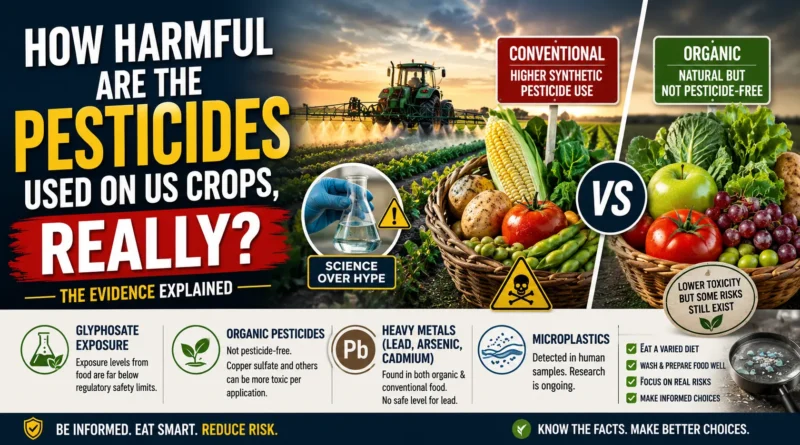
How Harmful Are the Pesticides Used on US Crops, Really?
If you’ve spent any time on food-safety threads, you’ve seen the same argument on repeat: one side says glyphosate is a slow-acting poison, the other says organic food is just conventional food with better marketing. Both sides usually skip the part that actually matters – the dose, and what you’re trading one risk for when you switch.
Here’s a grounded look at what the evidence says about glyphosate, the pesticides used in organic farming, and the other contaminants (heavy metals, microplastics) that rarely make it into the conversation but arguably deserve more attention.
Glyphosate: how much are people actually exposed to?
Glyphosate is the world’s most widely used herbicide, sprayed on corn, soy, wheat, oats and dozens of other crops. The core public-health question isn’t “is it in food” – it clearly is – but “is the amount in food anywhere close to a harmful dose.”
The regulatory numbers say no, by a wide margin. The EPA’s chronic reference dose is roughly 1.75 mg per kilogram of body weight per day, and dietary modeling studies that tracked people eating US-style, Mediterranean, and vegetarian diets found that even at the 95th percentile of exposure, people take in a tiny fraction of that limit – typically under 1 mg a day against a threshold that would allow well over 100 mg a day for an average adult. Urinary biomonitoring backs this up: exposure through food generally comes out to under 3% of Europe’s more conservative acceptable daily intake.
That’s the reassuring part. The messier part is that “safe” here rests on regulatory reference doses derived mostly from higher-dose animal studies, and there’s genuine scientific disagreement about whether those studies fully capture chronic, low-dose effects — particularly on the gut microbiome and hormone signaling, areas that older toxicology testing wasn’t really designed to catch. The World Health Organization’s cancer research arm (IARC) classified glyphosate as a “probable human carcinogen” in 2015, a call that remains an outlier among major regulators (EPA, EFSA, and a joint WHO/FAO panel have all concluded dietary exposure isn’t a cancer risk), and newer animal research is starting to probe prenatal and multi-generational effects at doses well below EPA’s safety threshold. None of this has moved regulatory limits yet, but it’s an active area, not a closed one.
Practical takeaway: the amount of glyphosate the average person eats is well within the margins regulators consider safe, by a factor of dozens to hundreds. The honest uncertainty is around low-dose, long-term effects that current safety testing wasn’t built to detect well — not around acute poisoning risk, which is genuinely low.
Organic pesticides aren’t “no pesticides” – and some are more toxic per application
This is the part that surprises most people. Organic certification doesn’t mean pesticide-free; it means the pesticide has to come from an approved list, most of it “natural” in origin. Organic farmers legally use around 20–25 approved substances, versus roughly 900 synthetic options for conventional growers – a smaller list, but not a small amount of actual product applied.
The standout example is copper sulfate (often as Bordeaux mixture), the main fungicide organic growers rely on against mildew and blight, especially on grapes, apples, potatoes, and tomatoes. Copper doesn’t break down – it accumulates in soil indefinitely – and comparative toxicology studies have found copper-based fungicides carry significantly higher ecological risk than the modern synthetic fungicides they’d otherwise replace: several-fold higher toxicity to bees, beneficial insects, birds, and mammals in head-to-head comparisons. It’s also harsher on farmworkers historically (there’s a well-documented occupational lung disease from repeated copper spray exposure in vineyard workers) and, because organic rules require much higher application rates to achieve the same effect, total copper load per acre in some crops has been measured as higher under organic than conventional management.
That said, the bigger academic comparisons paint a more favorable overall picture for organic-approved actives. A 2022 toxicological review of the EU pesticide database found that 55% of conventional-only active substances carried a formal health or environmental hazard classification, versus just 3% of organic-approved ones – and warnings about reproductive toxicity or suspected carcinogenicity showed up in 16% of conventional actives and essentially none of the organic list. So copper sulfate is a genuine, well-documented exception to a general pattern, not proof that organic pesticides are worse on average.
Practical takeaway: organic food isn’t pesticide-free, and its main workhorse fungicide has a legitimately worse ecological and accumulation profile than several synthetic alternatives. But across the full list of approved substances, organic pesticides skew toward lower acute toxicity and fewer chronic-hazard classifications than conventional ones. “Organic = harmless” and “organic pesticides are worse” are both oversimplifications.
The contaminants nobody’s arguing about: lead, arsenic, cadmium, and microplastics
This is where the Reddit thread’s instinct is worth taking seriously – because unlike glyphosate, these aren’t even a live regulatory debate about whether they’re a problem, just about how fast the fix is happening.
Heavy metals – arsenic, lead, cadmium, mercury – aren’t sprayed on; they’re absorbed from soil and water as crops grow, which means organic and conventional food are exposed almost identically (arguably organic is more exposed in a few cases, since copper accumulation and other soil-conditioning differences don’t reduce background metal uptake). FDA’s own Total Diet Study found lead in about 15% of food samples and arsenic in 43%, with arsenic showing up in nearly 40% of fruit samples and specific staples – rice, rice cereal, chocolate, spices, root vegetables – running consistently higher than the rest of the food supply. Inorganic arsenic is classified as a Group 1 (confirmed) human carcinogen by WHO, and for lead specifically, regulators are explicit that no safe exposure threshold has been identified – unlike glyphosate, where there’s at least an established “below this and you’re fine” number, lead’s official position is that any measurable amount is worth reducing further. That’s why FDA’s “Closer to Zero” initiative exists at all, and why it’s specifically targeted at infant and toddler food, where a small body and higher intake per kilogram magnify the risk.
Microplastics are the newest and least settled piece. FDA’s current public position is that the science doesn’t yet demonstrate that the levels typically found in food pose a health risk – but that’s a statement about insufficient data, not a clean bill of health. Microplastics have already been detected in human blood, organs, and stool, and both FDA and the CDC currently have dedicated working groups trying to figure out what that actually means, expected to report findings in the next couple of years.
Practical takeaway: if the goal is minimizing measurable health risk rather than picking a side in the organic-vs-conventional culture war, heavy metals are the stronger case for concern – they have an identified mechanism of harm, no established safe floor for lead, and they affect organic and conventional food close to equally, so “buy organic” doesn’t meaningfully solve for them. Microplastics are a legitimate open question, but currently under-evidenced rather than confirmed harmful.
Where that leaves you
Ranked by how much attention the evidence actually supports, rather than how much media coverage each gets:
- Heavy metals (arsenic, lead, cadmium) – the strongest case for genuine concern, especially for children, and not something organic purchasing solves.
- Glyphosate – exposure through food sits far below current safety thresholds; the real open question is narrow (long-term low-dose effects) rather than acute risk.
- Organic-approved pesticides (copper sulfate especially) – not the “safe alternative” the organic label implies, though the broader organic pesticide list does skew less hazardous than the conventional one.
- Microplastics – plausible future concern, but the current evidence doesn’t yet support a specific risk claim either way.
The most useful individual-level move, if you want one: eating a varied diet (rather than heavy reliance on any single high-residue food – rice, oat products, and certain juices repeatedly show up as outliers for both glyphosate and heavy metals) does more to cut cumulative exposure than choosing organic over conventional across the board.